
How a 12-location restaurant group replaced four vendors with one revenue engine
A 12-location restaurant group was paying four separate vendors — website, SEO, ordering, and paid media — and getting siloed reports from each, with no way to see what actually drove a customer. We consolidated the stack onto our platform, unified attribution, and rebuilt their menu sites with structured data and direct ordering. Customer acquisition cost dropped 38% and direct-channel orders grew 2.1×.
The context
A multi-unit restaurant group operating 12 locations had grown its marketing the way most groups do — one vendor at a time. A web agency owned the sites, an SEO firm owned rankings, an ordering platform owned online orders, and a paid-media shop owned the ads. Each was competent in its lane, but no one owned the customer end to end, and the group was paying four retainers for the privilege.
What was holding them back
Because four vendors ran four disconnected systems, attribution was impossible: the ordering platform claimed the orders, paid media claimed the clicks, SEO claimed the traffic, and nobody could say which dollar actually produced a paying customer. Reports arrived siloed and on different calendars, so leadership spent meetings reconciling conflicting numbers instead of making decisions. Worse, a big share of orders flowed through a third-party platform that owned the customer relationship and took a cut, while the group's own menu sites were slow, thin on structured data, and hard to order from directly.
What we ran
We consolidated the entire stack onto our platform — website, SEO, ordering, and paid media under one roof — so there was one system of record instead of four. We unified attribution end to end, so every order could be traced back to the channel, campaign, and location that produced it. Then we rebuilt their menu sites with first-class structured data (so menus and locations were machine-readable for search and maps) and direct online ordering that kept the customer — and the margin — with the group instead of a third party.
The outcome
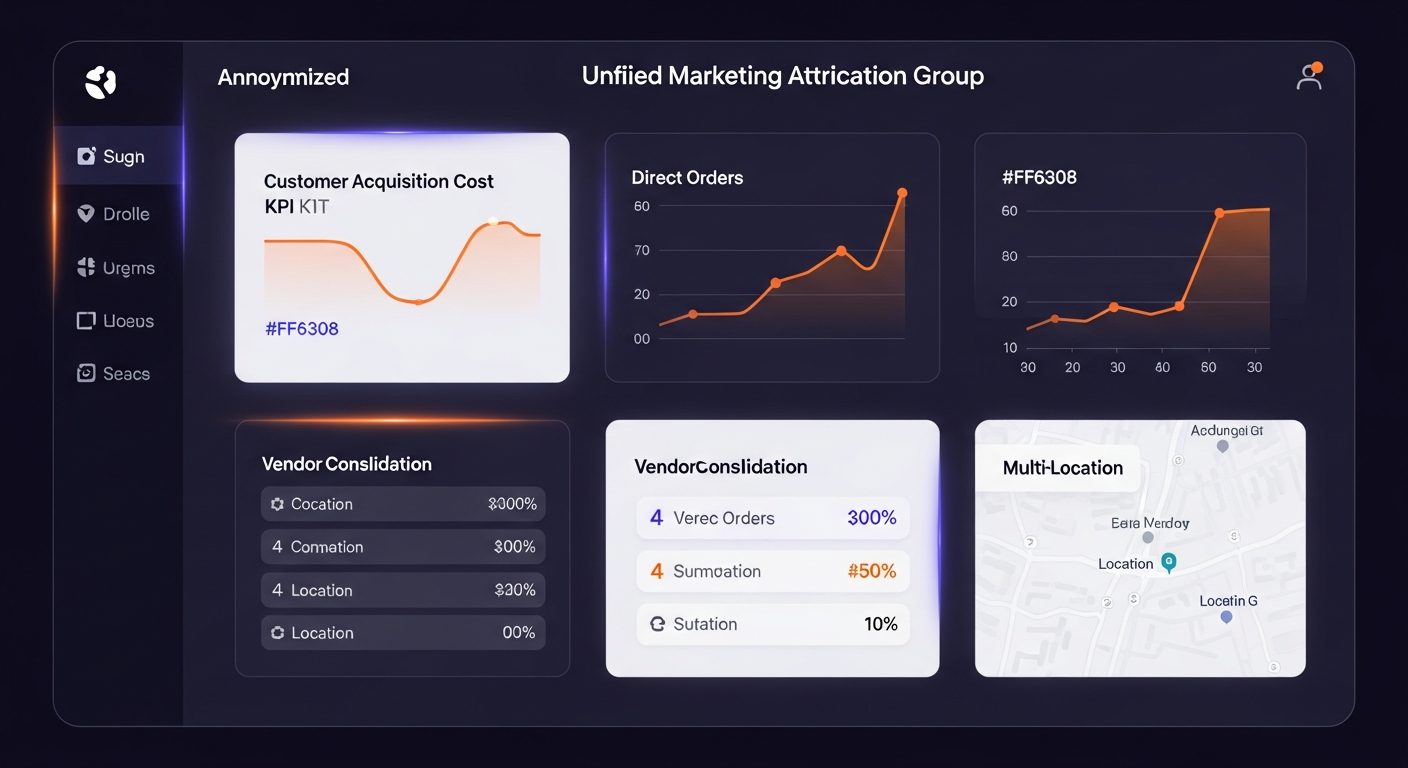
Customer acquisition cost dropped 38% once spend was guided by unified attribution instead of four vendors each optimizing their own slice, and direct-channel orders grew 2.1× as the rebuilt menu sites pulled volume back from third-party platforms that had been taking a cut. Leadership replaced four conflicting vendor reports with a single dashboard covering all 12 locations, so the monthly meeting moved from reconciling numbers to acting on them.
Anonymized and representative of the work — not a guarantee. Your results depend on your starting point.
More marketing case studies
How a multi-clinic wound-care group cut cost-per-appointment from $1,356 to $126
A seven-clinic wound-care group across the NYC metro was paying a sitting CMO and agency fees on top of an unmanaged website and paid search with no conversion tracking — they couldn't see what their ad spend was doing. We took over the marketing, rebuilt the site on our platform, and fixed analytics end-to-end. Cost per appointment fell from $1,356 to $126 while total spend dropped 37%.
Read the case studyHow a Series B health brand went from invisible to 47 AI citations in 90 days
Competitors were getting cited in ChatGPT and Perplexity answers while this Series B health & wellness brand was invisible in the prompts that mattered to their category. We deployed the AI Mention Tracker, closed the structured-data gaps on their authority pages, and shipped the fixes — taking them from 0 to 47 AI citations in 90 days and lifting branded search 61%.
Read the case studyWant more customers? Let's grow it.
Tell us where the growth is stalling. We'll map it out in a 30-minute call and show you what it takes to bring in more customers.