Why your scheduler should know your floor plan
Most scheduling software treats your business as a flat list of time slots. The actual constraint is physical, not temporal. Encoding it is easier than vendors want you to think.
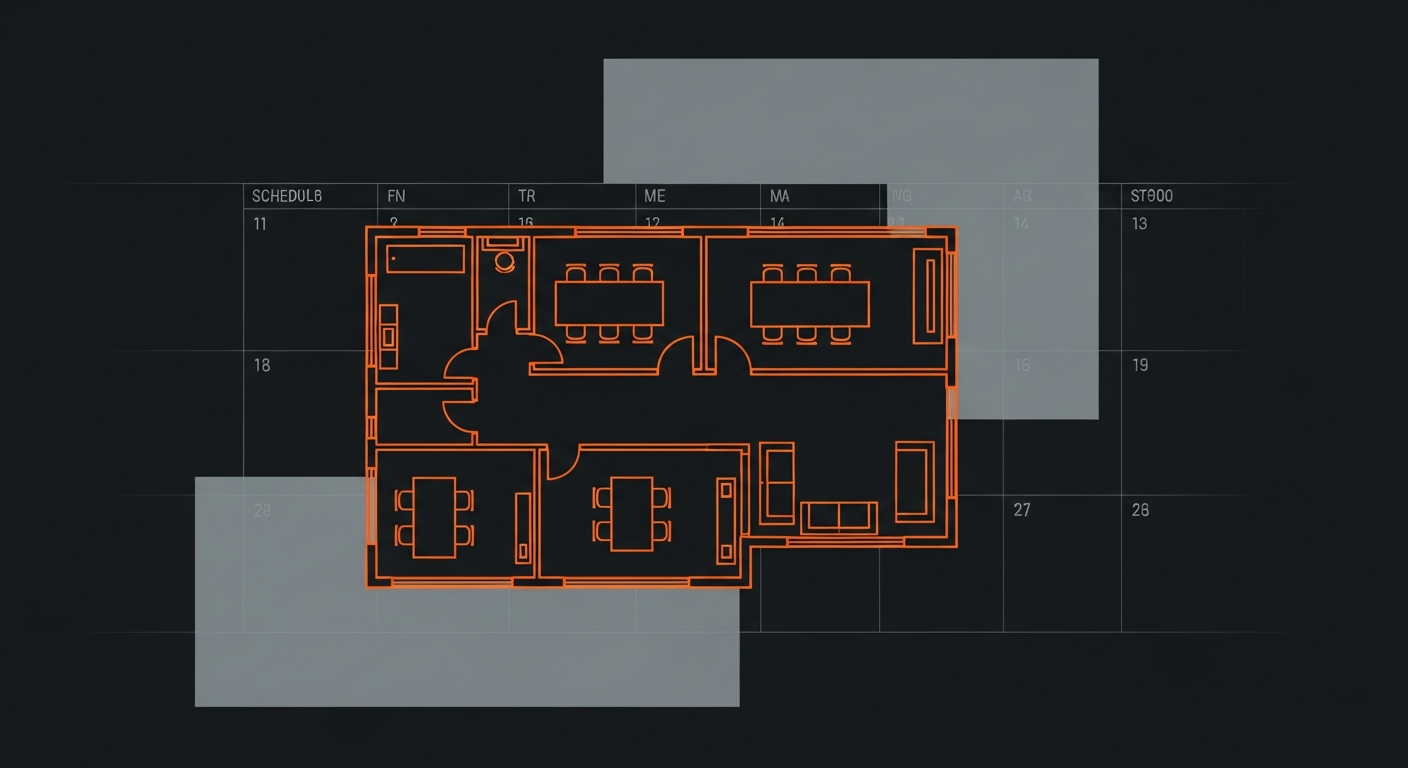
Most scheduling software — restaurant reservations, salon appointments, medical bookings, fitness classes — treats your business as a flat list of available time slots. The system asks: "Is the time available?" and ends there.
The actual constraint is almost never just time. It's physical. It's the room, the chair, the table, the equipment, the practitioner, the prep window. A booking that fits on a calendar but not in the floor plan is not actually a booking — it's a problem you'll discover at the door.
This is why we built the Intelligent Scheduler with the floor plan as a first-class primitive, not an afterthought.
Where flat schedulers fail
A few examples from our own client logs.
Restaurant, 60 seats, 12 two-tops + 6 four-tops + a private room for 8. A flat scheduler that takes a 6-top reservation at 7:30 PM might commit you to splitting two four-tops, which means losing flexibility for the rest of the evening. Or worse, accepting two simultaneous 6-tops with no plan to seat them both.
Salon, 4 stylists, 3 chairs, 2 wash stations. A flat scheduler will book a service that requires a wash, a cut, and a color across three different stylist time slots. It will not notice that the wash stations are saturated for 90 minutes in the middle.
Medical practice, 6 exam rooms, 2 procedure rooms. A flat scheduler will book a 30-minute consultation immediately after a 60-minute procedure in the same room without the 15-minute room turn that the practice's actual workflow requires.
In each case, the system happily took the booking. The operator paid for it later — in delays, walk-outs, frustrated staff, and customers who don't return.
What encoding the floor plan actually requires
Three things.
1. Resources have to be modeled, not just time. Tables, chairs, rooms, equipment, practitioners — each is its own resource with its own availability. A booking consumes a combination of resources for a window of time.
2. Resource interactions matter. A wash + cut + color is one booking that consumes a wash station, a chair, and a stylist, in a specific order, with specific dependencies. Encoding this is not optional.
3. Constraints have to be soft, not hard. In real operations, a 6-top might combine two four-tops if the operator decides to. The system should know the difference between "physically impossible" and "operationally suboptimal." The first is a hard refuse. The second is a yellow flag with a manager override.
What changes when you do this
Three things, measurable from week one.
Walk-out reduction. Restaurant clients see 30-50% reductions in seating-related walk-outs in the first 60 days. Customers don't show up to a full house when the system has correctly accounted for the floor.
Higher utilization. Counterintuitively, a scheduler that knows the constraints books more total revenue, not less. The floor plan turns out to be an optimization problem, not a limitation. We see 8-15% revenue lifts on the same physical footprint, common in restaurants and salons.
Less manual override. Front-of-house and reception staff stop spending time fixing booking errors. The labor recovered is real.
What to do this week
If you're using a flat scheduling tool — OpenTable, Calendly, Booksy, vanilla Google Calendar — try this exercise:
- Walk your floor with a notepad.
- Write down the constraints that aren't on your booking system: who can use what, when something has to happen before something else, what combinations are physically impossible vs. just inconvenient.
- Count how many of those constraints are encoded in your current tool.
The number is almost always close to zero.
If you'd like to see what an alternative looks like, the Intelligent Scheduler page walks through the architecture. It's also fully integrated into the rest of the Revenue Engine — bookings tie back to your CRM, attribution, and the lifecycle automations — so the constraint-aware reservation isn't sitting in a silo.